
Showing values for 100 g
Nutrition facts
per 100 g% DV = share of the FDA daily value for the selected amount.
Source: Open Food Facts · Confidence: 90% · Barcode (EAN): 7611916159046 · Data last verified:
Compare Sanddorn Saft with another foodLog Sanddorn Saft in one tap
You just looked it up. Let the app remember it. Dietly tracks your calories and macros automatically, so you hit your goal without the math.
- Barcode scanner
- AI photo logging
- Free to download
Common questions
How many calories are in Sanddorn Saft?
Sanddorn Saft by Weleda has 321 kcal per 100 g.
How much protein is in Sanddorn Saft?
Sanddorn Saft contains 0.5 g of protein per 100 g.
Is Sanddorn Saft high in carbs?
Yes — carbohydrates provide 95% of its calories (75 g per 100 g, of which 67 g is sugar). It also delivers 2.8 g of fiber.
Is Sanddorn Saft high in sugar?
Yes — 67 g of sugar per 100 g, roughly 17 teaspoons. Sugar makes up 89% of its carbohydrates.
Is Sanddorn Saft low in sodium?
Yes — just 100 mg per 100 g (4% of the daily value), which qualifies as low sodium.
Why does Sanddorn Saft have a Nutri-Score of D?
Nutri-Score weighs negatives (calories, sugar, saturated fat, sodium) against positives (fiber, protein) per 100 g. Points against come from sugar (67 g). Overall that places it in band D.
How much Sanddorn Saft is 100 calories?
About 31 g of Sanddorn Saft equals 100 kcal. It is energy-dense, so small amounts add up quickly.
Is Sanddorn Saft a good source of vitamin C?
It is a good source: 80 mg per 100 g, about 89% of the daily value. A 200 g portion covers roughly 178%.
More Other foods
Explore all → Sirop Vital - 500 Ml - Sirop Vital280 kcal · 0.5g proteinC
 Raisins SultaninesM-Budget,Migros316 kcal · 3g proteinC
 Bio Feigen GetrocknetMigros306 kcal · 3g proteinD
 VioplusActilife287 kcal · 3g proteinC
 Mangoschnitze GetrocknetMigros, Sun Queen, Sun Queen Migros306 kcal · 1.9g proteinC
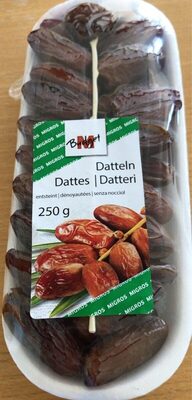 DattesM-Budget298 kcal · 2.5g protein
Want this data in your app?
Free API access — barcode lookup, full-text search, macros, micronutrients and Nutri-Score for every food in the catalog.
Explore the Dietly API